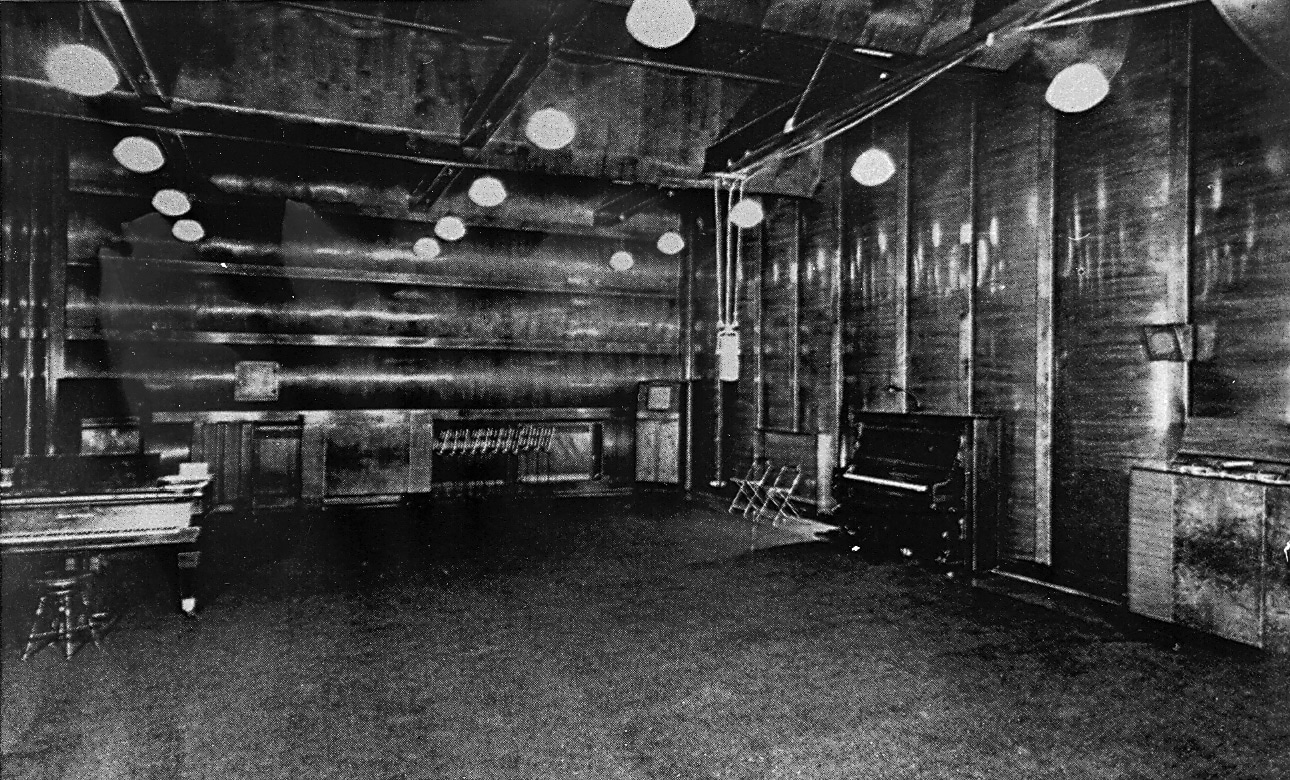
At a tango event last weekend, I found myself having two separate conversations about the restoration work we do at Tango Time Travel. Interestingly, both ended with almost exactly the same question: “Will you use AI to make historic recordings sound as if they had been recorded today?” Neither seemed to doubt that such a thing would soon be possible, if it was not already.
At first sight this seems like a perfectly reasonable assumption. Throughout the history of recorded sound, every technological advance has promised to bring us closer to the music itself. We have learned how to reduce noise, remove clicks and crackle, correct speed fluctuations, recover damaged recordings and reveal details that were previously hidden beneath the limitations of the medium. And now we seem to have crossed another threshold. We can use generative technologies to reconstruct information that was never actually captured in the recording, creating plausible approximations of sounds that may once have existed in the studio.
When I asked my friends why they would want that, they answered: “To recover all the information that was present in the studio when the orchestra was playing. To hear the real thing, the real sound.”
And this is where Pandora’s box opens.
What exactly is the real thing? Is it the sound that existed in the studio before the recording was made? Is it the sound perceived by the musicians themselves as they played? Or is it the recording, the result of that performance? The more one thinks about it, the less obvious the answer becomes.
To understand why, it helps to leave tango aside for a moment and look at other forms of art. Would we ask that a nineteenth-century painting be recoloured because modern pigments allow for brighter colours? Would we rewrite a novel in contemporary language because certain expressions have become old-fashioned? Would we transform a charcoal drawing into a photograph because photography is closer to visual reality? Most people instinctively reject such ideas because they understand that the medium is part of the work. The medium is not a neutral container carrying an artistic message from one place to another. It shapes the message itself.
A photograph is not a painting with more realism. A film is not a theatre play with a camera. A novel is not a film without images. Each medium creates its own way of seeing, feeling and understanding. More importantly, each medium tells stories differently. A painting can condense an entire world into a single image. A photograph captures a unique instant. A novel can enter the thoughts of a character. A film unfolds through time, movement and montage. None is simply a more or less accurate version of another. They are different artistic languages.
Sound recording is no different.
The shellac disc is not merely an imperfect attempt to preserve a live performance. It is a medium with its own grammar, its own aesthetics and its own narrative possibilities. The restricted frequency range, the compression, the balance imposed by the recording horn or microphone, the slight veil that separates us from the musicians, all these elements participate in the experience. They are not external accidents. They are part of how the music reaches us and how we imagine it.
When we listen to Troilo, Di Sarli, D’Arienzo or Pugliese today, we are not simply listening to an orchestra. We are listening to an orchestra through a particular historical medium. The medium itself becomes part of the story.
The desire to make old recordings sound modern is not new. In fact it has accompanied almost every technological transition in the history of recorded music. When shellac recordings were transferred to LP in the 1950s and 1960s, engineers did not simply copy them. They interpreted them. In the 1970s echo and reverberation became fashionable and many historical tango recordings were reissued with additional reverberation because listeners associated a larger and more spacious sound with higher fidelity. Today these interventions often sound strange, even distracting. Yet at the time they were considered improvements.
The same happened with equalisation, stereo simulations, dynamic processing, noise reduction and countless other techniques. Every generation believed it possessed a better understanding of how the recordings should sound. Every generation unintentionally moved a little further away from the original document.
The process reminds me of the children’s game of Chinese whispers. A message is passed from one person to the next. Each participant hears almost the same thing, makes a small modification and passes it on. No individual change appears dramatic. Yet after twenty repetitions the final message may have little in common with the original.
Historical recordings often suffer from the same phenomenon. One transfer engineer adjusts the speed slightly. Another adds reverberation. A third applies aggressive noise reduction. A fourth uses an incorrect playback curve. A fifth compresses the dynamics. A sixth applies AI enhancement. Every intervention may appear reasonable when considered in isolation. Taken together they create a new object.
The paradox is that attempts to modernise historical recordings often reveal more about the period in which the transfer was made than about the period in which the music was recorded. The added reverberation tells us something about the sound ideals of the 1970s. The excessive noise reduction tells us something about the digital optimism of the 1990s. The AI reconstruction tells us something about our contemporary fascination with data recovery and simulation. But none of these necessarily tells us more about Troilo, Di Sarli, D’Arienzo or Pugliese.
This is why restoration requires restraint. The question should not be: “How can we make this recording sound like today?” The question should be: “How can we hear what is already there without replacing it with ourselves?”
Across disciplines, restoration work generally follows a few fundamental principles. Make small and carefully considered interventions. Ensure that interventions are reversible whenever possible. Preserve the integrity of the original work. Avoid imposing a new contemporary aesthetic onto a historical object.
The goal is not to recreate a work as if it had been produced today. The goal is to allow the work to speak as clearly as possible in its own historical language.
At this point we may have to abandon the idea that realism is the ultimate goal of art. This assumption appears surprisingly often. Faced with an abstract painting, some people will say: “I could have painted that myself.” Faced with modern music: “That’s just noise.” Faced with an old recording: “Wouldn’t it be better if it sounded like a modern studio production?” Behind these reactions lies the same conviction: artistic value is measured by how closely a work reproduces reality.
Yet the history of art suggests exactly the opposite. The greatest artistic breakthroughs often occurred when artists moved away from realism rather than towards it. Photography did not make painting obsolete. On the contrary. Once painters were no longer required to imitate reality, they could explore colour, form, emotion and perception in entirely new ways. Impressionism, Expressionism, Cubism and Abstract Art were not failures of craftsmanship. They were expansions of artistic possibilities.
Art is not merely the reproduction of reality, art is the creation of meaning. The shellac recording belongs to this broader history. Its value does not lie in how accurately it reproduces the acoustics of a room in Buenos Aires in 1941, but in the particular experience it creates. The recording is not simply a transparent window onto a past event. It is a form through which that event becomes meaningful.
When people ask whether AI could reconstruct the orchestra exactly as it sounded in the studio, they assume that the highest artistic goal is realism, the closest possible approximation of physical reality. Yet art rarely works that way. When we look at a drawing, we do not wish it were a photograph. When we read a novel, we do not complain that it contains fewer visual details than a film. The power of art often lies precisely in what it leaves unsaid.
Every medium imposes limitations. These limitations create spaces of interpretation, what literary theorists call Leerstellen, gaps that the observer, reader or listener must complete with their own imagination. Paradoxically, these absences are often part of what makes art powerful. The shellac recording contains such gaps. Its frequency range is limited. Some details are blurred. The room is only partially revealed. The orchestra appears before us through a veil of technological constraints. But this veil is not merely a defect. It invites us to listen actively, to imagine, to participate. The recording does not give us everything. It asks something from us.
This may be why the fascination of historical recordings has survived for more than a century. Their appeal is not despite their limitations. It is partly because of them.
There is another reason why I would not want Golden Age recordings to sound as if they had been recorded today. The sound itself is the result of a conscious artistic process. These musicians did not enter the studio with the intention of creating an abstract musical work that would later be translated onto shellac. The recording session was the artistic act. The orchestra gathered in a room. The musicians listened to each other. They balanced their playing according to the position of the microphones. They performed together, often in a single take, knowing that the result would be cut directly onto a disc.
In many respects these sessions resembled a live performance more than a modern studio production. The recording was not a secondary by-product of the musical event. It was the destination itself.
What we hear today is therefore not merely a document of a musical event. It is the result of a complex encounter between musicians, instruments, acoustics, recording engineers and technology. Every element participated in the creation of the final sound. The shellac record became the vehicle through which that moment was transmitted into the future.
The purpose of restoration is not to make Troilo, Di Sarli, D’Arienzo or Pugliese sound contemporary. The purpose of restoration is to allow Troilo to sound more like Troilo, Di Sarli more like Di Sarli, D’Arienzo more like D’Arienzo and Pugliese more like Pugliese.
The goal of restoration is therefore not to reconstruct an imaginary reality that exists somewhere behind the recording. Nor is it to transform the recording into something that conforms to contemporary expectations of sound quality. The goal is more modest, and perhaps more ambitious at the same time. It is to help the recording reveal what it already contains, to clarify the voices without replacing them, to uncover musical details without rewriting history, and to make the work more accessible without changing its language.
I want to recover as much as possible from Golden Age recordings. Every note, every orchestral colour, every nuance of phrasing that can be revealed without altering the nature of the document is worth preserving.
But I do not want them to sound as if they had been recorded today.
Because what fascinates me is not a hypothetical modern version of Troilo, Di Sarli, D’Arienzo or Pugliese. What fascinates me is the encounter itself: musicians gathered in a room, listening and responding to one another, creating something together in a particular moment that could never be repeated.
The shellac disc is not an obstacle standing between us and that moment. It is the bridge, not because it allows us to return to the past exactly as it was, that is impossible, but because it carries the traces of a unique encounter between living human beings, all of whom have now disappeared.
The musicians are gone.
The recording remains.
And perhaps that is where its magic truly resides.