Osvaldo Fresedo meets Dizzy Gillespie

The other day while looking at the later Osvaldo Fresedo Orchestra I found a very nice recording of Vida mía from 1956 where the voice of the singer is substituted with Dizzy Gillespie‘s jazz trumpet.  What a great recording! Most of the later recordings by Fresedo starting with the 1950s are to my taste not so well fitted for dancing in modern milongas (at least I haven’t found yet any usable tangos by Fresedo from this period). When Fresedo was performing in the USA at that time he even announced his music as jazz music.

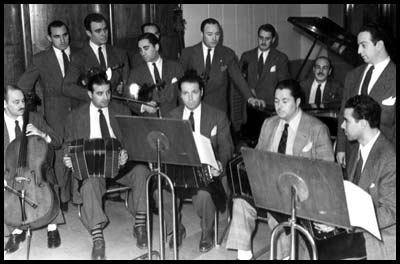
In 1956 the famous north American jazz trumpeter Dizzy Gillespie was on a visit to Buenos Aires and arrived one evening in Osvaldo Fresedo’s night club called Rendezvous Porteño. As the Fresedo Orchestra performed tangos from their repertoire, Dizzy Gillespie improvised on his trumpet. This was a historical meeting of two unique sounding musicians and a tangent between tango and jazz which mainly evolved separately, even concurrently at that time.

During my dj-set on the 31st of December in Amsterdam on a new year eve milonga at the Academia de Tango, I have been looking for a nice last tanda which could be happy, profound and marking the turn of the year. The trumpet voice is ideal for literally blowing away the old year, some musical onomatopoeia, I imagine that it’s the sound of the angel passing by and sweeping away the old year.

See here my tanda of the new year’s eve:

  1. Cordobesita, Osvaldo Fresedo : Roberto Ray, 1933, 2:34
  2. En la huella del dolor, Osvaldo Fresedo : Roberto Ray, 1934, 2:49
  3. Isla de Capri, Osvaldo Fresedo : Roberto Ray, 1935, 3:17
  4. Vida mía, Osvaldo Fresedo : Dizzy Gillespie (in vivo), 1956, 4:12
  5. La cumparsita, Osvaldo Fresedo (Instrumental), 1943, 2:20

In the 4th piece the voice of Roberto Ray, the sweet singer, is getting replaced by the heavenly trumpet of Dizzy Gillespie .


This version of Vida Mía is taken from the Acqua Records CD Osvaldo Fresedo Rendezvous Porteño con Dizzy Gillespie AQDP002.  This album contains four tangos together with Dizzy Gillespie, all live recordings. The other tangos are mainly recordings from broadcasted radio of theater shows and the ending track is an interesting interview with Osvaldo Fresedo from 1968.

One of the tangos, Adiós muchachos, is unadvised to be play when you have superstitious tangueros in the milonga. It is actually considered as the sung testament and farewell of Carlos Gardel who died in an aircrash in 1935 and playing it, or even worse, dancing it, would bring bad luck ;-)


By the way, I use at least one other tanda with a trumpet voice, it’s very present in the Francisco Canaro CD album Candombe, EBCD 108, which holds a selection of his tangos from 1941-1949. Especially when you listen to En esta tarde gris, the trumpet voice is very present, it is in the background though and doesn’t replace the singer. Some of the tangos on this collection have a very jazzy touch and can make a nice fresh dancing tanda.


Time stretching too fast El Bandoneón recordings

I was recently looking at the Edgardo Donato recordings in my collection when I noticed that some of the same tangos produced at the same recording date differ in duration. Certain El Bandoneón recordings are of a shorter duration than the corresponding recordings from other labels. I recalled that I have read before articles on tango blogs which mention this problem: Several El Bandoneón recordings are too fast in speed and therefore show a too high timbre (The problem seems to be even wider spread and is not limited exclusively to the El Bandoneón label).

Edgardo Donato A Media Luz EBCD95 containg the speedy Chapaleando barro version on track number 7

In the case of my Edgardo Donato recordings I checked on the title Chapaleando barro from the recording year 1939 (31st of August 1939 according to tango.info) and recognised that all other CD labels present the same duration of the music part in the recording which is 2:28 min (2:31 with beginning and ending silence). The El Bandoneón recording is shorter: 2:17 min (2:19 min with silence) which makes a clearly perceivable difference of 0:11 sec. Chapaleando barro from El Bandoneón is much faster and the voices and instruments are distorted and sound too high! Here are the sound samples without any processing:

  • This is the original El Bandoneón version of Donato’s Chapaleando barro taken from the CD A Media Luz 1935 – 1942 EBCD95 before my processing, it’s too fast and too high in timbre:

    Audio clip: Adobe Flash Player (version 9 or above) is required to play this audio clip. Download the latest version here. You also need to have JavaScript enabled in your browser.

  • And this is a sound sample of my reference version of Donato’s Chapaleando barro taken from the japanese CD Qué Lindos Tiempos Viejos Vol. 22 AMPCD1265, both tempo and pitch sound perfect to me:

    Audio clip: Adobe Flash Player (version 9 or above) is required to play this audio clip. Download the latest version here. You also need to have JavaScript enabled in your browser.

Therefore I decided to pass the El Bandoneón Chapaleando barro through a time stretching filter in Audacity, a very versatile open source sound editing software. The literature on time stretching algorithms allows to believe that the current state of art is quite good, especially when stretching at low percentages like in this situation.

As all CD labels must have used either the same master 78 R.P.M. or a circulating record copy of the original recording from 1939, I tried first to figure out what could have happened during the transfer to CD in the El Bandoneón studio and came up with three theories:

  • A turntable in their studio was running too fast maybe at round 80 R.P.M., certain labels like Pathé produced records which used to be played back at 80 R.P.M.
  • A turntable was out of order and therefore running at a slightly higher speed which also confirms that the speed difference is not always exactly the same as I later noticed on other distorted El Bandoneón tangos.
  • They used a variable speed turntable and manually affected arbitrary speeds between 78 – 85 R.P.M according to what sounded good in their ears, maybe even intentionally increasing speed to please their customers and a taste for faster music.

I would be curious to know what happened exactly in that studio but I think the 3rd theory is the most plausible.


For the tango recording Chapaleando barro I calculated a speed difference of 8,2 % which would suggest that the playback speed during the transfer of the record must have been at around 84.396 R.P.M. (Please see this blog contribution on other methods for determining the acceleration factor, when you don’t have any reference tango at the correct speed at hand for a precise calculation).

To correct this kind of recording error the corresponding Audacity filter is called Change Speed, affecting both Tempo and Pitch under the Effects menu. I wanted to inverse the error and therefore reduce the speed while correcting the pitch (changing to lower notes) and the tempo (lower BPM). Let’s see practically how to process:

Open the sound file with Audacity’s open dialog. Select the whole sound file via the Edit menu, select all. Call the Change Speed, affecting both Tempo and Pitch filter dialog via the Effects menu.

In the filter window the correction percentage has to be introduced with a negative prefix: -8.2 % as we want to have the filter slowing down the speed of the sound file.

Audacity filter Change Speed, affecting both Tempo and Pitch

Prior to applying the filter check that the whole sound file is selected:

Best is to save the resulting file with a different name and the same meta-data, so you can later compare the duration if you have some reference versions of the same tango in your collection. To save the file use the Export menu which you can access via the File menu. Once the export is done, drop all changes to the open file. This permits to keep the original speedy sound file.

See here the original sound sample, before:

  • Audio clip: Adobe Flash Player (version 9 or above) is required to play this audio clip. Download the latest version here. You also need to have JavaScript enabled in your browser.

And here the processed slowed down version, after:

  • Sound sample of the restored El Bandoneón version of Donato’s Chapaleando barro, after being passed through the Audacity filter:

    Audio clip: Adobe Flash Player (version 9 or above) is required to play this audio clip. Download the latest version here. You also need to have JavaScript enabled in your browser.

I draw several frustrating conclusions form this experience. The first is that I recognise that I can’t trust some El Bandoneón recordings for accurate speed and I also see that DJs who are working directly with CDs, the old way, are potentially unable to correct these errors as you can’t just pitch these tracks down without getting some inversed Mickey Mouse effect. And the second is that it would take ages to correct all the speed problems with this kind of tangos, the filter passage can be time consuming depending on your CPU. What a waste! But after all it’s not so dramatic ;-) there is also the possibility to just tag these tangos as fast versions. Some DJs told me that they play the fast versions when the mood of the evening is demanding for faster music.

Not everything coming from El Bandoneón is bad. In fact when I browse through my listings, I can see only a small amount of speedy versions. I like a lot of their CD editions because they have also compiled nearly for each CD a nice leaflet with extra information and the quality of their transfers is often quite amazing. I just recently brought back a big bunch of recordings from Barcelona. There is a very good shop close to the metro station Maria Christina called Blue Sounds where they have a huge selection of El Bandoneón CDs for takeaway. The shop is affiliated with the tango label but mostly specialised in Jazz records, most of which are coming from their own label. The shopkeeper told me that El Bandoneón stopped producing 3 years ago and soon when the stocks are sold out, these recordings will not be available anymore.

First CDs arrived right from Japan!

Against any expectation today my door bell ringed quite early … It was the postman with a nice little packet. I received the first set of CDs from the Japanese label A.M.P. They are all produced by the famous collector Yoshihiro Oiwa and contain some rare tangos. Good to have some friends in Japan ;-)

At first sight I’m particularly happy with the Julio De Caro milonga and tango recordings.


The mysterious Emilio Pellejero

Some years ago I attended a tango marathon and while I was dancing a never heard milonga has been played: Mi vieja linda. It has been an unforgettable moment of dance. Even though I never heard this tango before it sounded familiar to me. That might sound paradoxal but it confirms that well dancable tangos you might play for the first time form some kind of exception when it comes to acceptance by the audience. Generally people I have been talking to, don’t like too much to dance to music they don’t know very well. When I played this milonga for the first time at a local milonga in Brussels, it had the same déjà vu effect on the most recalcitrant dancers.

As I later was told, this milonga has been performed by the Orquesta Emilio Pellejero in 1941. I found a recording at the Uruguayan record label Sondor the CD is called El Tango de los 40, Inéditos de Sondor, Sondor catalogue number 8.200 – 2.

According to Todotango.com Emilio Pellejero recorded some other tangos with Sondor but to my knowledge none of these recordings seem to be reissued on CD. The person record on Tango.info is even more limited and states that the overall performances of this orchestra is estimated to 4. All these performances point to the two Sondor CD samplers El Tango de los 40, Inéditos de Sondor and Tangos para la Historia (1944 – 1948) with reissued tangos mainly recorded in Uruguay. Curiously Tango.info just shows a birth date for Emilio Pellejero, as he was born the 1st of November 1911, he might party his 100th birthday in a couple of days if he is still alive.

So, unless I know better this person’s work, I suppose there are a lot of lost works around on some vinyl records or 78 RPMs waiting to be discovered. Let’s start to search for it ;-) Here is the tanda how I play it:

  1. Milonga oriental, Ángel Sica (Instrumental), 1942, 1:57
  2. Mi vieja linda, Emilio Pellejero : Enalmar De Maria, 1941, 2:26
  3. Rebeldía, Ángel Sica : Romeo Gavioli, 1942, 2:20

As this milonga tanda is quite short or if you like to play 4 milongas, you could add the following milonga at the beginning of the tanda:

  1. Flor de milonga, Rogelio Coll : Enrique Campos, 1942, 2:11

They all work perfectly well together and are on the same Sondor CD. It is also worth to note that Sondor’s masters seem to be in a bad condition or that they have grabbed these tangos from a damaged 78 RPM. I would really love to get hold on better quality recordings.

Copyrights on tango music and the idea of a public domain milonga

Recently I was discussing with a friend who is a milonga organiser about how he handles the royalty payments at his milonga. Normally as a DJ or dancer you don’t need to care so much about these issues and when you own a title or CD you have a personal use license. The organiser of a milonga on the other hand has to care because the collecting societies are watching.

As the friend is playing quite often music from one particular contemporary argentinian tango orchestra with whom he has a friendship relation, he told me that he puts explicitly the names of this orchestra on his listing that he transmits to the collecting society but when he later asked the friends if they received any money from Belgium they answered: “No”. Strange isn’t it? The money seems to get into some pool and the retribution doesn’t seem to be related to what is really played but to some other obscure factors. So if you play Di Sarli at a milonga the collecting society and the majors might give the money to Madonna or some other idol not directly related to tango ;-) .

Chau PinelaSome time ago, I stumbled upon a Wikipedia page which shows a listing of tango music which is in the public domain. Mainly from Guardia Vieja (before 1916) and some time later. Generally a work get’s into the public domain when the author is dead for 70 years. This is the case for instance in Argentina, Belgium and Germany. For the aforementioned Di Sarli recordings this means that they will get into the public domain in 2030 as he died in 1960. Then again there might be problems when using CD-transfers as they could be considered as works on their own. For being able to play Di Sarli royalty-free in 2030 one might need to get hold of the old 78 RPM records and do the transfers. Things might get even more complicated if Di Sarli wasn’t the composer of the tango. This is the case with the tango Chau Pinela!, the composer is Humberto Castiglione and according to SADAIC the copyright holder. This matches with the info on bibletango.com:

Chau Pinela
Genre : Tango – Date : xxx – Musique : Castiglione, Humberto – Paroles : Castiglione, Humberto -  
     Enregistrement original : Date: 03/09/1930 Lieu : Buenos AiresOrchestre : Carlos Di Sarli Chant : Fama, Ernesto – Durée : xxxLabel : xxx – Disque : xxx – Matrice : xxx -
Compilation
* :
Date
: 2005 – Lieu : Buenos AiresArrangement : xxxDurée : xxx – Label : Todo Tango/Roberto Rial – Disque : Compil. MP3/2005/ Vol 1 -


Could be fun to organise once a public domain tango milonga but everybody would need to be very quite as most of these tangos which entered the public domain until now have been acoustically recorded and they sound like sent through an old telephone. And last but not least one needs to do quite some research to get through the jungle of composer, author, interpret and so on …

Acoustic recording

Acoustic recording, Frances Densmore recording Blackfoot chief Mountain Chief on a cylinder phonograph for the Bureau of American Ethnology (1916)

Cortina discussion

Some people asked me about the cortinas I play between the tango tandas. The musical genre is called rembetiko. These rembetikos are original recordings from the 1930s and 1940s. Wikipedia says about rembetiko: [...] Rembetiko is a kind of Greek cultural music that developed around ports and urban centres in the end of the 19th and up to the first half of the 20th century, with the bouzouki as its main instrument. [...] Like several other urban subcultural musical forms such as the blues, flamenco, fado, and tango, rembetiko grew out of particular urban circumstances. Oftentimes, but by no means always, its lyrics reflect the harsher realities of a marginalized subculture’s lifestyle. Thus one finds themes such as crime, drink, drugs, poverty, prostitution and violence, but also a multitude of themes of relevance to Greek people of any social stratum: death, eroticism, exile, exoticism, disease, love, marriage, matchmaking, the mother figure, war, work, and diverse other everyday matters, both happy and sad.

See here a selection of four songs which I use among others to build cortinas:

  • Minore tu teke by Ioannis Halkias, 1932
  • O buffedsis by Jiorgos Batis, 1935
  • Beikos by Spyros Peristeris, 1935
  • Σούρα και μαστούρα, Δελιάς Ανέστης, 1936

Σούρα και μαστούρα

Όταν μπουκάρω στον τεκέ, τον αργιλέ τσακώνω
Και με τα φυλλοκάρδια μου τραβώ, τον ξελιγώνω

Του ντεκετζή ξηγήθηκα να τον ξαναπατήσει
Κατά κακή μου σύμπτωση σώθηκε το χασίσι

Και ξεμπουκάρω απ’τον τεκέ, μες στην ταβέρνα πάω
Δύο ποτηρίες εφετινό κάθομαι κοπανάω

Σούρας, τρελός, αν έγινα, κι έφυγα απ’ την ταβέρνα
Για το τσαρδί μου πάγαινα, είχα γίνει στην πένα

Drunk and intoxicated

If I go into tekes, I grab the argiles / and pull the heart of whole,
smoke it done / I’ll tell tekedsis, he should make it back full / an unhappy chance, is all the hashish /
(voice of stratos) jia sou anestos mou derwisch!
and I was storming out of the tekedes, and go into the tavern / booze and a few glasses of wine this year’s harvest / “crazy” by the drink, I leave the tavern, I’m going home and I’m in very good mood.


rembetika

Album cover Rembetika

For further listening I recommend the album Rembetika Songs Of The Greek Underground 1925-1947

You can listen to it here: http://www.youtube.com/watch?v=wJDJloPBN08


Trial and error: Digitising my tango CD collection

notes

DJ-Set milonga at Brussel's Royal Yacht Club August 2011


When I started digitising my existing tango CD collection, I thought that  OGG Vorbis would be a good choice as a compression format. Especially the El Corte DJ manual stresses that most of the older tango recordings until the wider spread of the stereo recordings in the late 50s contain rarely more than 100 Kbit of information and therefore a low bitrate MP3 compression should be the most suitable. So I went for OGG Vorbis as the digital audio format for my collection because I’m a Linux user for more than 15 years and OGG Vorbis is an open source codec very common on all major Linux distributions. OGG Vorbis is also known to provide better sound quality at lower bitrates than MP3. Another important reason why I didn’t use MP3 are the patent and license issues involved with this codec.

After some weeks of hard encoding work I received more and more up-to-date information about the encoding chain, which I will explain later, and most important, the existence of lossless audio codecs, like FLAC. I also read some tests results which I have been able to reproduce partially in my home studio: OGG Vorbis encoding creates artifacts especially at lower bitrates and partially damaged source audio files, like old tango recordings. Let’s mention the short pops of a vinyl recording which can result in a drop like end result with a lossy codec.

I therefore decided to drop everything and to reencode the whole collection in a lossless audiophile format. The advantages are that I have now a CD-quality digital collection on my computer with a very nice sound timbre, every song can be tagged like with Vorbis or MP3, you can even embed the cover art (front, back, inline, etc) and several pages of scanned CD folders into each song title! FLAC is also based on an open-source license and there are no patent issues. Among audiophiles it is currently traded as the best lossless codec with the highest audio quality and interoperability. Once the collection is in a lossless form it can be transcoded into any lossy (MP3, OGG Vorbis, etc) or other lossless formats and one can even go back to WAW for restoring the initial Audio-CD. An inconvenient is that FLAC encoded files take more disk space than lossy formats, typically it reduces the original audio material to 50-60% of its initial size. Which is a fair compromise as hard disks are cheap and large today.

My current encoding chain is as follows: I use an external USB connected LG GE20-LU10 Multidrive to read the Audio-CDs. The extraction of the audio stream and FLAC encoding is done via the graphical frontend K3b which uses the excellent command line tool Cdparanoia. Cdparanoia reads audio from the CDROM directly as data, with no analog step between, and writes the data to a file or pipe in WAV, AIFC or raw 16 bit linear PCM. The data gets then transcoded to FLAC on the fly and ends up in my Music folder for further processing. Not to forget, before inserting the CDs into the drive I clean them. I recognised the importance of this step as one CD didn’t pass the encoding process and the encoder exited after a few tracks. After cleaning and repairing of the scratches it passed without errors. Also, when the CD is dirty certain sectors might not be readable and the encoder could apply some undesired interpolation.

Egon Ludwig's Tango Dictionary

Egon Ludwig's Tango Dictionary

Next step is tagging the song titles as the provided info via CDDB is often incomplet and contains a lot of typing errors. For the moment I’m happiest with Easytag, it has a very interesting scanning function which permits for batch editing all song titles at once (also across several albums) and can add cover art into the FLAC metadata fields. I mostly use the Tango.info database to crosscheck all titles and correct errors, adding the recording dates and singer names. (I haven’t yet worked out how to directly integrate the Tango.info database into my tagger as their tools seem to be crafted mainly for Windows but I will certainly dig deeper into this soon as it could save some time.) As the Tango.info database is still incomplete, Bernhard Gehberger’s tracklistings are a very good hint for crosschecking, he did an excellent job by providing his tracklistings and other resources on-line. I also use Egon Ludwig’s Tango Lexikon (in german language, ISBN 3-89602-294-6). It contains a waste discography of 78 RPM, LP records and CDs. It seems to be out of print but there might still be some copies around. To my mind the tagging part is really important and it needs to be done in a very precise manner. It’s simple: when the song titles cannot be found later, they cannot be played ;-) .

For my first DJ-sets I used the Rhythmbox player software which maps on the Itunes way of working. I later decided to migrate to Mixxx as I want to adopt an improvised way of presenting the live set. I still use Rhythmbox for easily browsing my collection and my private playback. But I’m not happy with these playlist based programs. So I turned to Mixxx which enables me to see the waveform of each song and to organise my collection into crates. It also has a BPM detection and writes the collected info back into the FLAC metadata. With the multichannel sound card support, I can connect a headphone to a second sound card and pre-listen while the live stream is running. It also runs on 64bit systems and takes advantage of multi-core CPUs. Mixxx runs on a variety of operating systems like Linux, MacOS and different Windows versions. It cuts off all sound effects and other programs using the sound card (I still remember my worst dancing experience when the DJ at my local milonga, no names, received a Skype call during his Pugliese tanda, dring, dring, dring … :-) ). The Mixxx software runs rock solid on my Ubuntu Linux Laptop and there seem to be more features and design improvements to come after this summer. There is an interesting feature I haven’t used yet: Live streaming via a streaming server. I will test this soon.

I still use my Ipod classic for mobile playback and to dig into my collection. I’m not happy with it though as it doesn’t support anything else then MP3 and some Apple codecs but in revenge it has a big hard drive. So I just transcoded the whole collection from FLAC to MP3 to upload the copies on the Ipod (it takes a night to run through the whole collection, only for using the Ipod!). Meanwhile I’m dreaming of a FLAC mobile player with a big hard drive. After some search I found the SoundKonverter graphical interface which uses also Cdparanoia to do the batch transcoding for the Ipod preserving most of the metadata tags from the FLAC files. I end up with two music folders, one with the ripped CDs in FLAC format for the live DJ-sets and one with the transcoded MP3 files for my Ipod.

Tascam US-100 DAC

My main sound card for the PA system is an external Tascam US-100, it also has a connector for a turntable and could be used later to record 78 RPMs since the late 50s as it integrates a RIAA preamplifier and ground connector (earlier 78 RPM records use different preamplification schemes and you need to map these curves accordingly, see this interesting article from Tangovia). I like the volume button on the device which permits to control the loudness during the live set with a real hand as I don’t want to use replay gain. This is mainly because I prefer to adapt the volume according to the audience and trust my sound perception. For some difficult playbacks of poor quality recordings I use sometimes the equilizer function of Mixxx to adapt the high, mid or low ranges. Most of the time the raw stream of my encoded music provides the best music experience.